
Banff
★★★★★FiringBest of the week: Thursday around 16:00, 3–5 ft and offshore.
Seven days
best session each day · swipe| Wed 18 | Thu 19 | Fri 20 | Sat 21 | Sun 22 | Mon 23 | Tue 24 | |||||||||||||||||||||||||
|---|---|---|---|---|---|---|---|---|---|---|---|---|---|---|---|---|---|---|---|---|---|---|---|---|---|---|---|---|---|---|---|
| Time | 18 | 06 | 09 | 12 | 15 | 18 | 06 | 09 | 12 | 15 | 18 | 06 | 09 | 12 | 15 | 18 | 06 | 09 | 12 | 15 | 18 | 06 | 09 | 12 | 15 | 18 | 06 | 09 | 12 | 15 | 18 |
| Surf ft | 3–4 | 3–5 | 3–5 | 3–5 | 3–5 | 3–5 | 3–4 | 3–5 | 3–5 | 3–5 | 3–5 | 3–4 | 3–4 | 3–4 | 3–4 | 2–4 | 2–3 | 2–3 | 1–2 | 1–2 | 1–2 | 2–3 | 2–3 | 2–3 | 2–3 | 2–3 | 2–3 | 2–3 | 1–2 | 1–2 | 1–2 |
| Swell | 9s | 8s | 8s | 7s | 7s | 7s | 7s | 7s | 7s | 7s | 7s | 7s | 7s | 7s | 7s | 7s | 7s | 6s | 6s | 6s | 6s | 6s | 6s | 6s | 7s | 7s | 8s | 8s | 8s | 8s | 8s |
| Wind mph | 5 | 5 | 14 | 14 | 13 | 7 | 4 | 5 | 5 | 8 | 12 | 9 | 9 | 8 | 5 | 4 | 15 | 15 | 15 | 12 | 11 | 8 | 10 | 14 | 19 | 21 | 9 | 9 | 10 | 11 | 13 |
| Tide m | 3.3↑ | 3.1↑ | 2.9↓ | 1.9↓ | 2.2↑ | 3.3↑ | 2.9↑ | 3.3↓ | 2.1↓ | 1.8↑ | 3.0↑ | 2.6↑ | 3.5↑ | 2.5↓ | 1.5↑ | 2.6↑ | 2.1↑ | 3.6↑ | 3.1↓ | 1.4↓ | 2.0↑ | 1.6↑ | 3.4↑ | 3.6↓ | 1.6↓ | 1.5↑ | 1.2↑ | 3.0↑ | 3.9↓ | 2.1↓ | 1.1↑ |
| Rating | ★★★★★ | ★★★★★ | ★★★★★ | ★★★★★ | ★★★★★ | ★★★★★ | ★★★★★ | ★★★★★ | ★★★★★ | ★★★★★ | ★★★★★ | ★★★★★ | ★★★★★ | ★★★★★ | ★★★★★ | ★★★★★ | ★★★★★ | ★★★★★ | ★★★★★ | ★★★★★ | ★★★★★ | ★★★★★ | ★★★★★ | ★★★★★ | ★★★★★ | ★★★★★ | ★★★★★ | ★★★★★ | ★★★★★ | ★★★★★ | ★★★★★ |
Surf is the face height at the beach after the swell is filtered for the way Banff faces. Arrows point to where the swell and wind come from: an arrow pointing up means from the north. Tide is the height at Banff above chart datum, rising ↑ or falling ↓; the rating drops when the tide is outside the window this break works on. Amber marks the sessions worth setting an alarm for. From Sunday the swell comes from Météo-France's 10-day model, which is coarser than the 5 km German model used close in. Hours no model reaches are left blank, not shown as flat.
Exposure
Banff faces north. Measured from the seabed, it is open to swell from NW round to E; the brighter a wedge, the deeper the water in that direction and the more of the swell gets in. Anything from behind the headlands scores nothing, however big the buoy says it is.
- NE
- 1.2 m at 9 s (swell) · 100 % reaches the beach
- S
- 0.1 m at 1 s (wind sea) · blocked, 0 %
How Banff works
- Swell
- Best from the north.
- Wind
- Offshore is from the south; anything with north in it is onshore and messes it up.
- Tide
- all tides.
- Getting there
- Between Fraserburgh and elgin on the A98
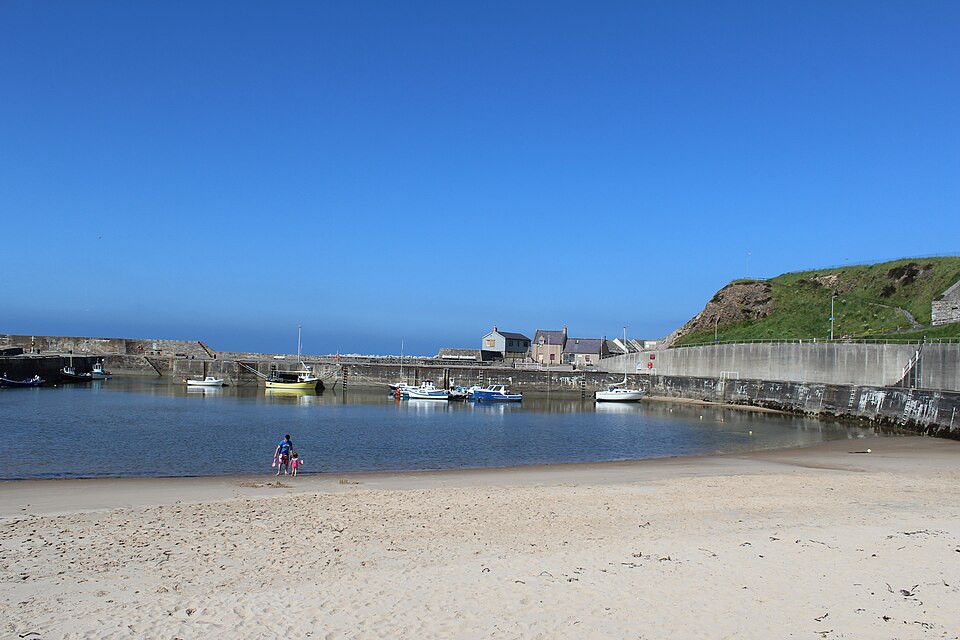
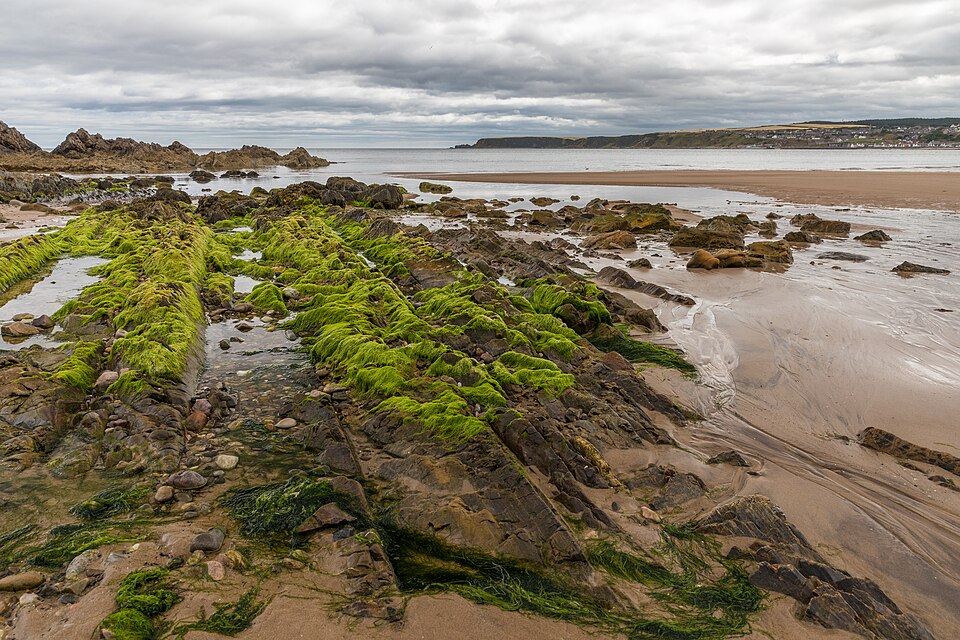
Has both reef and beach set ups.. a fickle reef and the east end, and a few breaks near the harbour and river mouth.
Tide times
- Wed 18:04High3.3 m
- Thu 00:42Low1.6 m
- Thu 07:02High3.2 m
- Thu 13:05Low1.8 m
- Thu 19:01High3.4 m
- Fri 01:34Low1.5 m
- Fri 08:09High3.4 m
- Fri 13:56Low1.7 m
Banff station, under 1 km away. Heights above chart datum, UK time.
Photos
In the gallery

Bill Harrison, CC BY-SA 2.0, via Wikimedia Commons. Bill Harrison, CC BY-SA 2.0, via Wikimedia Commons.
Nearby
-
 CullenBanfshire · faces N
-
 SandendSandend · faces N
- FraserburghFraserburgh · faces N